The house takes the first solar
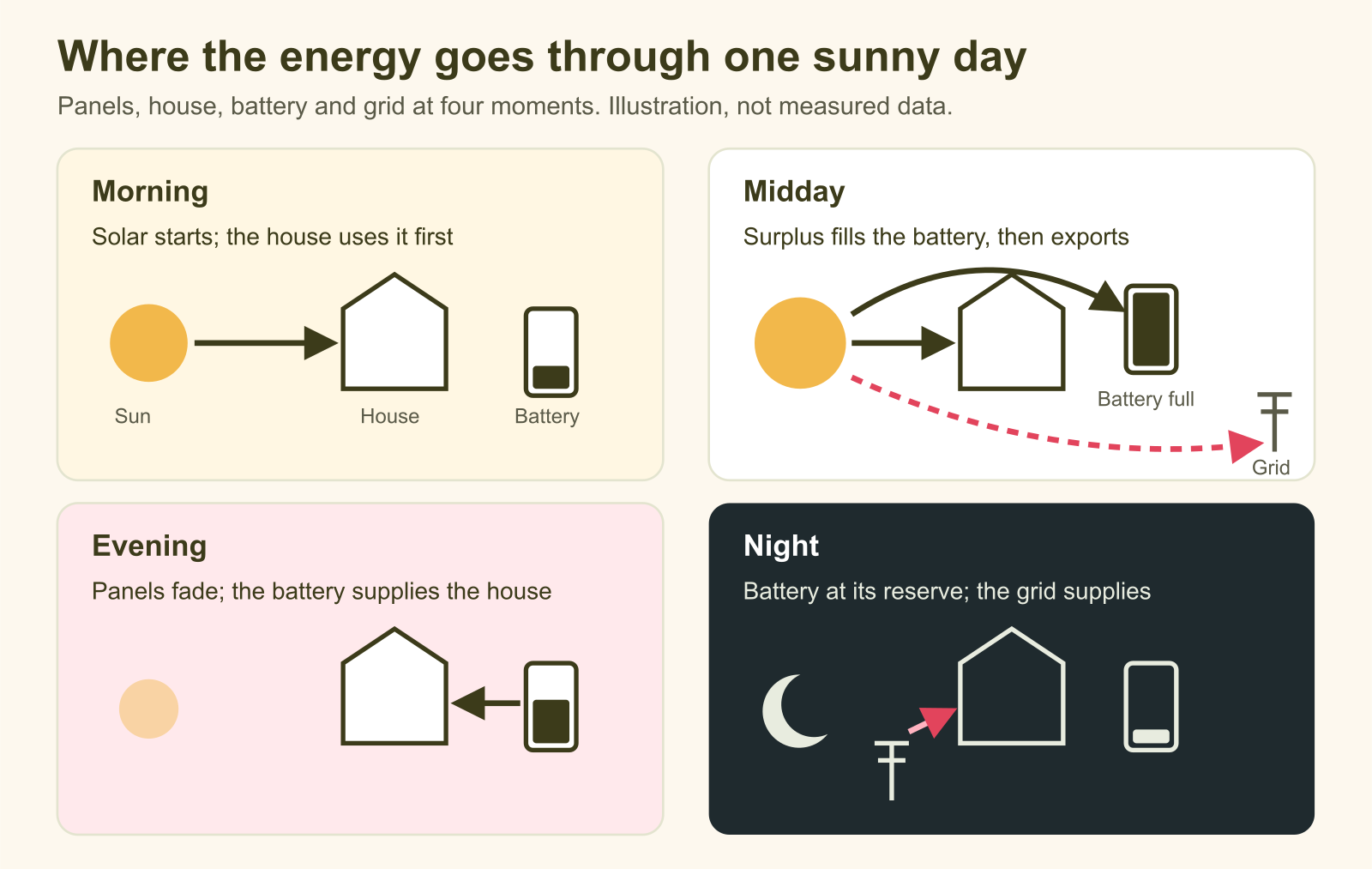
As the panels wake up, everything they make goes straight into the kettle, the fridge and whatever else is running. Nothing is left over yet, so the battery waits at the level it kept back overnight.
A battery moves electricity in time: from the middle of the day, or the cheap hours, to the evening when your home wants it. This guide works out how much that is for your home, season by season, and covers backup in a power cut, the fire-safety rules on where a battery can go, and the network paperwork. No prices, no sales pitch: energy, power and hours.
An illustration of one sunny day, not measured data. The battery fills from midday surplus, then carries the evening peak until it reaches the level it keeps in reserve.
In one paragraph: solar battery storage keeps electricity your panels make while you are out, or that a time-of-use tariff sells cheaply overnight, and gives it back when your home needs it, usually in the evening. It helps only with energy the home would otherwise export or buy at a dearer time, so its useful size is set by your evening and night use and by how much surplus there is to store, which changes a great deal between summer and winter.
Three setups cover almost every home. A battery added to panels you already have stores midday surplus. A battery fitted with new panels at the same time is designed with them, often around one hybrid inverter. A battery with no panels at all charges from the grid in cheaper hours. Any of the three can have backup for power cuts, but most do not by default.
More in battery terms.
Scroll through one sunny day. The same four moments happen in winter, but the midday surplus is much smaller and some days there is none.
As the panels wake up, everything they make goes straight into the kettle, the fridge and whatever else is running. Nothing is left over yet, so the battery waits at the level it kept back overnight.
Once the panels make more than the house is using, the extra charges the battery instead of flowing out to the grid. When the battery is full, the rest is exported, exactly as it would be without storage.
Cooking, lighting and screens push use up just as the panels fade. The battery supplies the house until it reaches its reserve, which is the part of the evening a battery is really for.
With the battery at its reserve, the house buys from the grid as it would anyway. On a time-of-use tariff, some setups refill the battery from the grid in the cheap hours, ready for tomorrow.
Installers registered with MCS estimate the share of a year's solar a home uses itself, with and without a battery, using a lookup-table method. Put the two shares from your quote into the explorer, with your panel size and yearly use, and it shows what the battery would add in kWh.
Two limits apply whatever a quote says. We never show more than 75% of generation used at home without a battery, or 90% with one, and a home can never use more solar than it uses in total. A secondary source notes the lookup method does not cover generation above 6,000 kWh a year, use outside 1,500 to 6,000 kWh, or batteries above 15.1 kWh, so treat a quote's figures with care at those edges.
The surplus the battery cannot hold is still exported, and you can be paid for it under the Smart Export Guarantee if your installation and meter qualify. Exporting from a battery explains how storage changes that.
About 3,860 kWh of solar a year
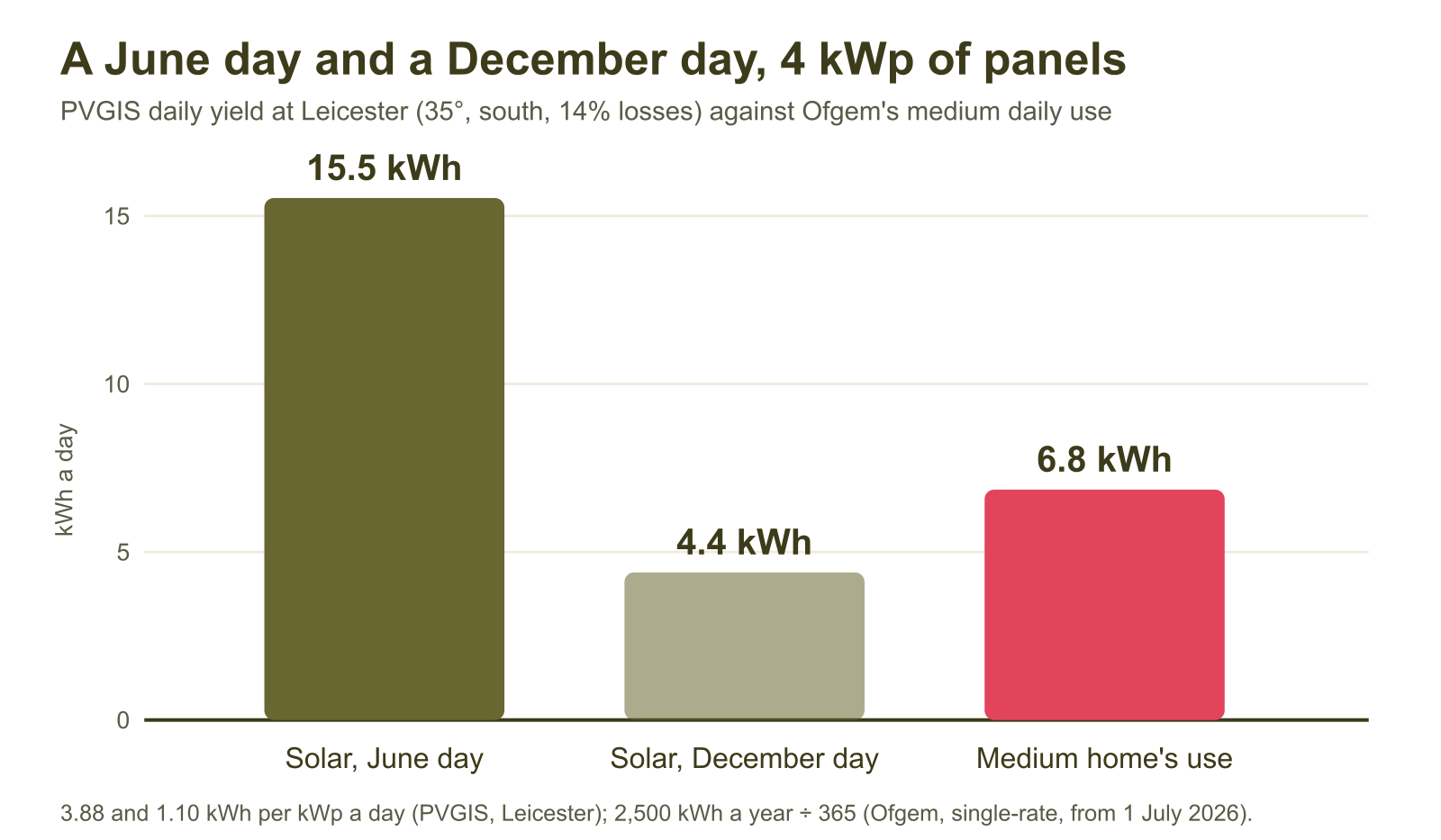
A 4 kWp array near Liverpool makes about 3,860 kWh in a typical year on PVGIS's figures. On a June day that is roughly 15.5 kWh; on a December day roughly 4.4 kWh (Leicester's monthly profile, used as the example).
Add the two self-use shares from your installer's quote to see how much more of it a battery would keep in the home in year one.
The European Commission's PVGIS tool puts Leicester's output at about 3.88 kWh per kWp of panels on a June day and 1.1 kWh in December, roughly 3.5 times more in midsummer. A 4 kWp array goes from about 15.5 kWh a day to about 4.4 kWh, while a medium-use home still uses about 6.8 kWh a day in both months, and usually more in winter.
So in December most of what the panels make is used as it is made, and there is little or nothing left to store. A battery sized to soak up every kWh of a June afternoon will sit partly empty for months. That is why we size from evening use first and surplus second. The winter and summer guide goes month by month, and what size battery turns your own figures into a usable size.
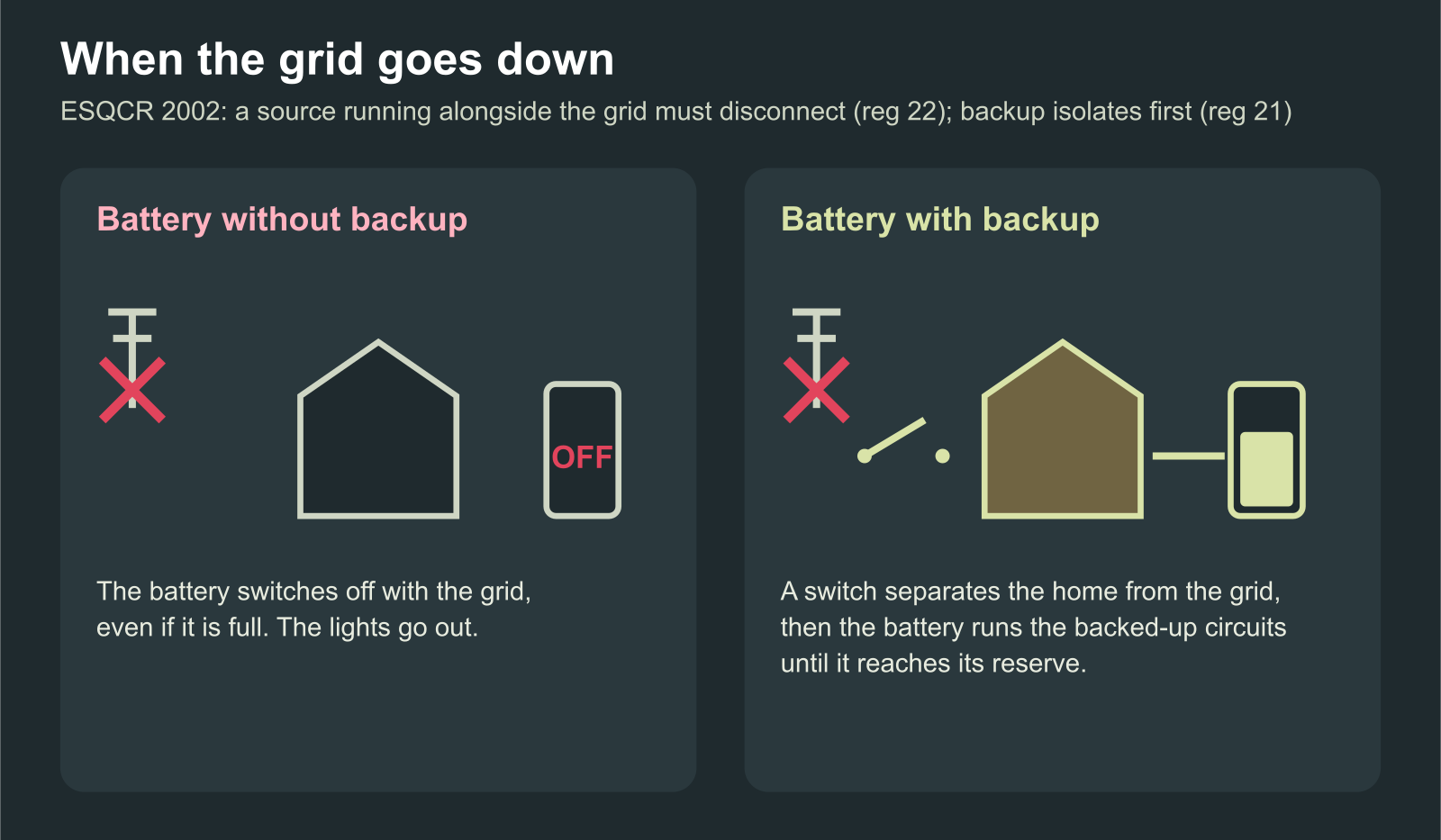
The Electricity Safety, Quality and Continuity Regulations 2002 require a source running in parallel with the network to disconnect itself when the network supply is lost (regulation 22). That protects people working on the lines. A battery with no backup function simply stops, however full it is.
Backup adds switching that first separates your home from the grid, which regulation 21 requires of a switched alternative source, and then lets the battery run chosen circuits until it reaches its reserve. How long that lasts depends on the usable energy above the reserve and the power of what you keep on. Backup in a power cut has a runtime estimator.
PAS 63100:2024, the BSI specification sponsored by DESNZ for protecting homes from battery fires, prefers an outdoor spot or a separate outbuilding. It bars bedrooms, escape routes such as halls, landings and stairs, cupboards opening into bedrooms, lofts, roof spaces and voids. Indoors elsewhere, it asks for fire-resisting separation, ventilation to the outside and, in rarely visited spots, an alarm linked to the rest. It also caps storage at 20 kWh per enclosure and 40 kWh per home in most places (80 kWh outdoors or in a separate building). Where to put a home battery takes it clause by clause.
Every battery has to be notified to the local network operator. The law asks for the operator to be told before or at commissioning; in practice small systems use G98 within 28 days, and storage over 3.68 kW goes through G99 before installation. See G98 and G99 for a home battery. At handover you should receive the user instructions, including how to shut the battery down and what to do in a battery fire, and a statement that the installation conforms to PAS 63100.
With those, you can read the technical side of any quote: usable kWh, power in kW, round-trip efficiency, coupling, warranty energy and the network route. Comparing battery specifications shows how. Questions about cost are covered by a separate price guide; this one stays with energy and fit.
Paying for storage, in three sentences: there is no national grant for a home battery anywhere in the UK. The Warm Homes Loan Scheme is borrowing that must be repaid. Warm Homes: Local Grant can fund a battery for some lower-income homes in England, but only alongside solar panels.
DESNZ's statistics on batteries registered with MCS in existing homes give a picture of real choices. In 2025/26, 37.9% of the batteries in the cleaned sample were under 6 kWh nominal, averaging about 5.1 kWh; 33.7% were 6 to 11 kWh, averaging 9.8 kWh; and 28.4% were 11 kWh or more, averaging 15.5 kWh. The share of the biggest band rose from 20.6% the year before. Those are nominal sizes; the usable figure on the specification sheet is usually a little lower.
Popular is not the same as right for your home. A large battery that rarely empties, or rarely fills, is storage that does little. The guide to what households install sets the figures out in full, and the guide to how a solar battery works explains the energy flows behind them.
Electricity your panels make that the house is not using at that moment. Without a battery that surplus is exported; with one, it is kept for later in the day, usually the evening. A battery can also be filled from the grid on a tariff with cheaper hours.
Rarely. It only stores surplus, only up to its usable capacity, and only after the house has taken what it needs. On long summer days a full battery means the rest is exported anyway. In midwinter there may be little or no surplus to store.
There is no single answer, but a useful starting point is the energy you use after dark. Ofgem puts a medium-use home on a single-rate meter at 2,500 kWh a year, about 6.8 kWh a day. The average battery registered with MCS in an existing home in 2025/26 was about 9.6 kWh nominal (DESNZ figures, our arithmetic).
Only if it has a backup function. By law, a source that runs alongside the grid must disconnect when the grid supply is lost, so a standard battery switches off in a cut, however full it is. Backup adds switching that separates the home first, then runs chosen circuits.
No. PAS 63100, the fire-protection specification for batteries in homes, lists lofts, roof spaces and voids among the places a battery should not go, along with bedrooms and escape routes.
Yes, always. Small systems are notified within 28 days of installation under G98; MCS says storage over 3.68 kW needs a G99 application before it is fitted. Your installer normally handles it.
Tell us a little about your home and what you want a battery to do. Your message reaches SEO-DONS LTD, which publishes this guide, and we answer by email. It costs nothing to ask and commits you to nothing.